In an era marked by the pursuit of sovereignty and strategic autonomy, is there still room for global solidarity? As nations prioritize autonomy and strategic independence, how can the spirit of international scientific collaboration be maintained? How can infrastructure contribute to such cooperation?
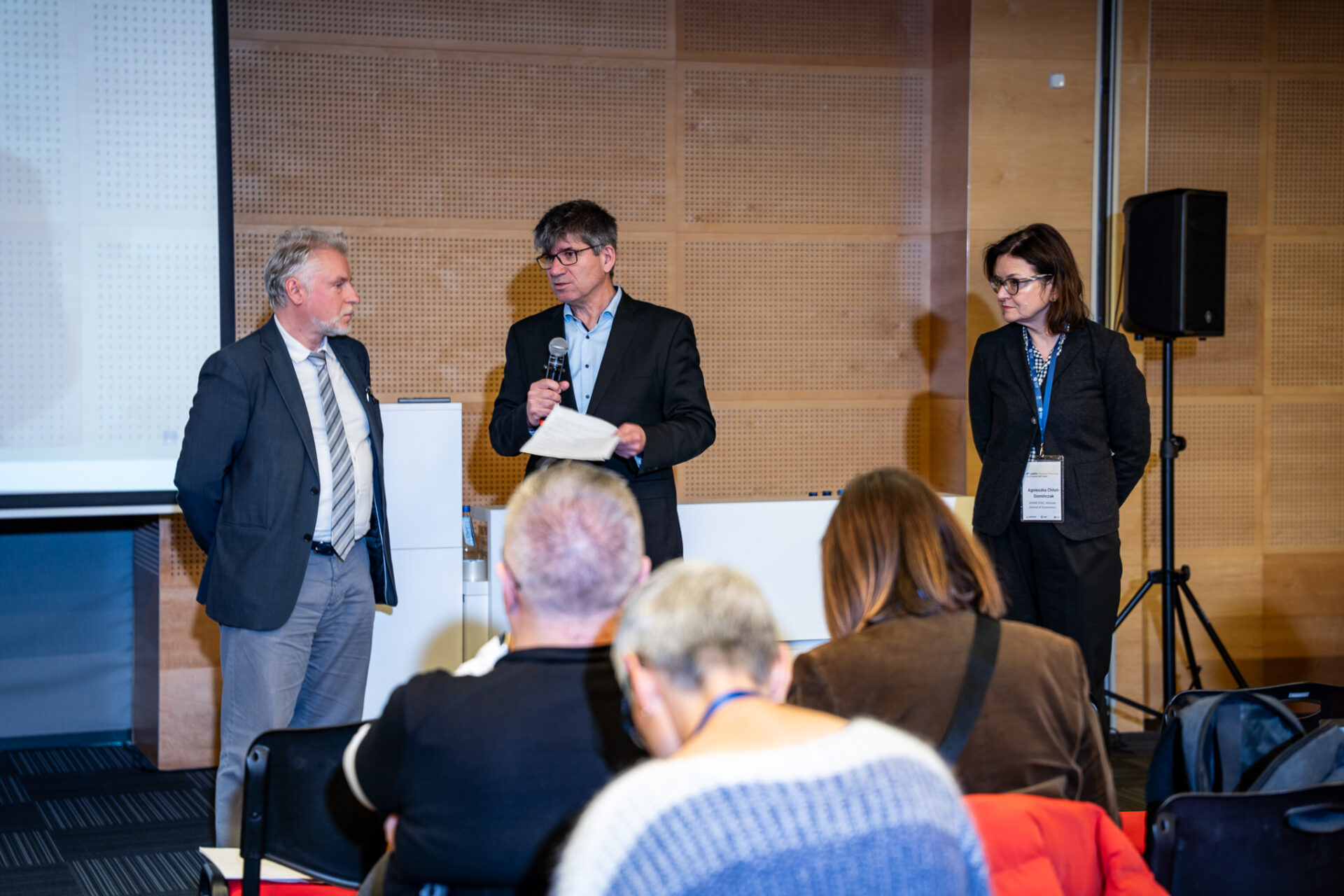
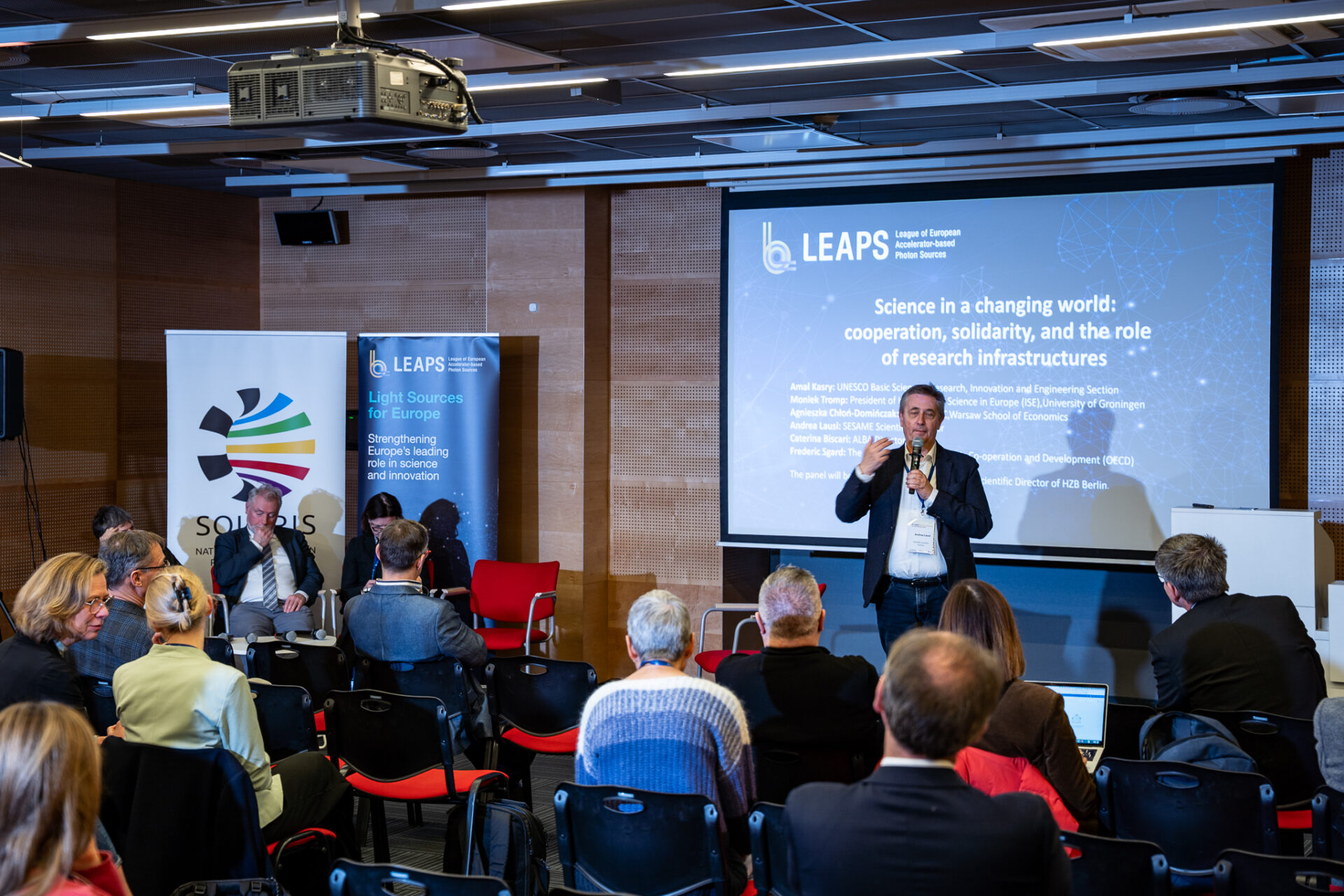
These and many other questions were explored by group of leaders taking part as part in 8th LEAPS Plenary Meeting hosted by SOLARIS in Krakow. A high-level panel convened on 14 November 2025 at the Krakowski Technology Park explore the role of science in a rapidly changing world.
Moderated by Prof. Bernd Rech, Scientific Director of Helmholtz-Zentrum Berlin and Incoming Chair of LEAPS, the discussion brought together experts from research, policy, and global organisations. Panellists such us: Amal Kasry – UNESCO Basic Science, Research, Innovation and Engineering Section, Agnieszka Chłoń- Domińczak- SHARE-ERIC, Warsaw School of Economics, Andrea Lausi – SESAME Scientific Director, Caterina Biscardi – ALBA Director and Frederic Sgard from the OECD Global Science Forum, examined how cooperation, solidarity, and shared research infrastructures can help address global social challenges, while balancing national priorities and strategic goals.
Research infrastructures – once niche facilities supporting narrow scientific communities – have become some of the most important engines of modern science. Over the past three decades they have expanded across disciplines, from physics and astronomy to environmental monitoring, materials science, and biomedicine. With that growth, expectations have changed. Policymakers now want infrastructures not only to advance knowledge but also to “deliver broader societal and economic impact,” as Frederick Sgard from OECD put it at the beginning of the panel.
According to OECD panellist, meeting these expectations requires a new model of collaboration. Its latest analysis argues that the future lies in research infrastructureecosystems-strategic partnerships where independent facilities commit to shared goals. “Facilities don’t lose their identity,” the speaker noted, “but they gain the power of coordinated action.”
Examples of ecosystems already exist. The LEAPS as the network of Europe’s light-source facilities, aligns upgrades, shares expertise, and boosts political visibility. The German Canadian Materials Acceleration Center (GC-MAC) unites different infrastructures around a single scientific mission. And regional clusters bring together diverse facilities to raise international profile and attract talent. These partnerships, Frederick says, “go beyond loose connections-they build active, purpose-driven collaboration.”
Ecosystems can help balance openness with security. By sharing cyber incident information, aligning security standards, and jointly training staff, they can strengthen resilience without undermining international collaboration. “We cannot sacrifice scientific openness,” the speaker concluded, “but we do need smarter, collective protection.” In a globalized research environment, infrastructure ecosystems may soon move from optional to essential.
UNESCO: Pushes Remote-Access Science to Build a Global Research Ecosystem
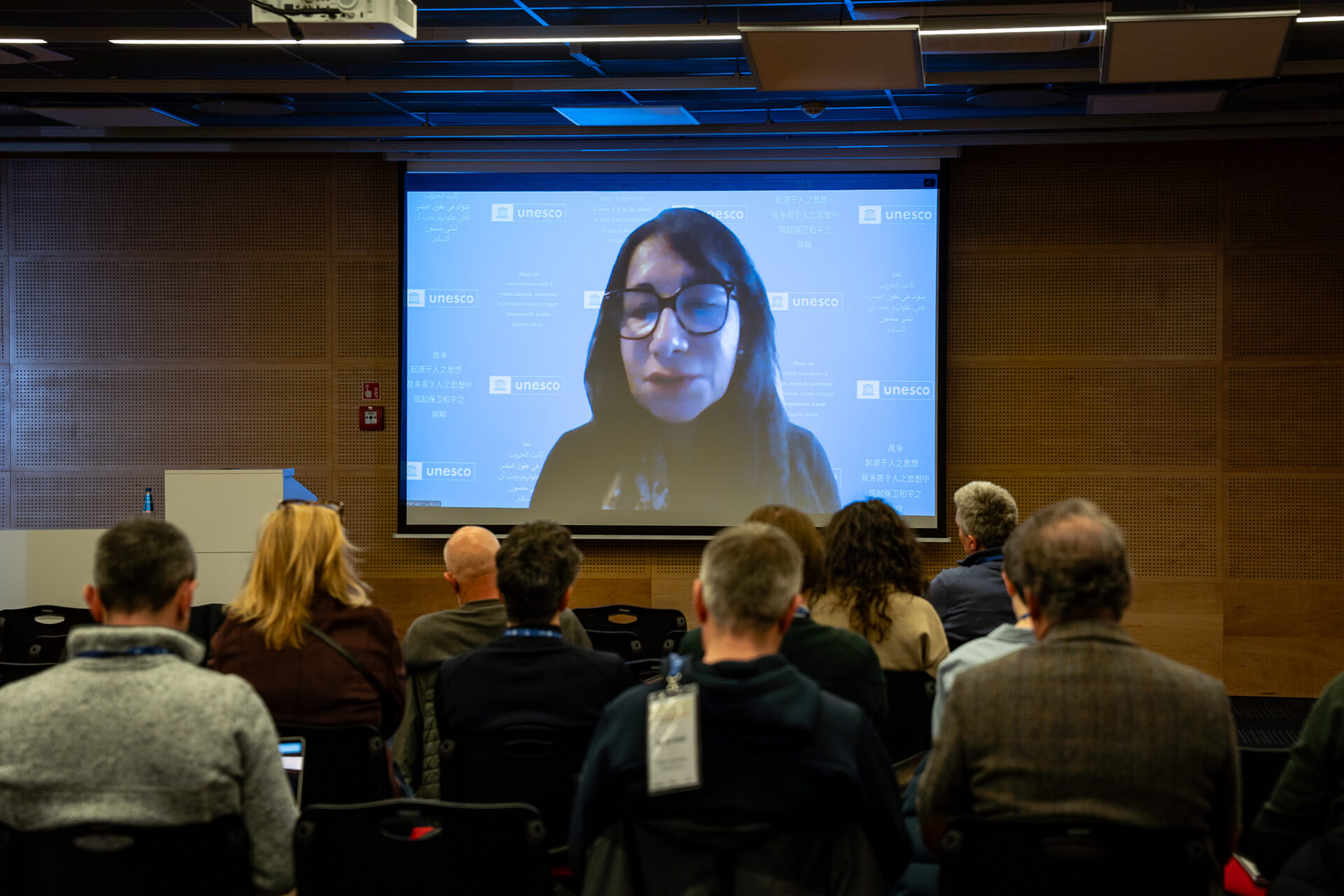
As global scientific challenges escalate- from climate change to biodiversity loss- international organisations are increasingly looking for new ways to level the playing field in research. Amal Kasry, Chief of the Section for Basic Science, Research, Innovation and Engineering at UNESCO, offered a perspective rooted in equity, access, and the future of global science. Kasry emphasized that fundamental and applied research are inseparable- and that this connection is essential for any modern scientific ecosystem. “Fundamental research cannot be separated from application,” she said. “This is really the entry point to ensuring the ecosystem, because you need both the basic and applied sciences working together.”
UNESCO’s work, she noted, is driven by the major crises facing humanity. However, one initiative stands out for its ecosystem-building potential: the Remote Access Initiative, launched three years ago. Its goal is simple but transformative – providing scientists, especially in Africa, with remote access to advanced laboratory equipment they otherwise could not use.
“Africa is a priority for UNESCO,” Kasry explained. The program now supports researchers in 13 African countries, initially offering access to single-crystal X-ray diffractometers and expanding to six sophisticated techniques. Scientists receive training and can operate the instruments remotely, thanks to partnerships with universities and research facilities willing to share their infrastructure. This model, she stressed, is rooted in UNESCO’s 2021 Open Science Recommendations. “It’s not only about open access,” she said. “It’s about sharing knowledge, sharing infrastructure, and reducing brain drain by empowering scientists to develop solutions themselves.”
Kasry sees this as a blueprint for a global research ecosystem – one that aligns with the International Decade of Sciences for Sustainable Development, which UNESCO leads. “We want major changes in how science is implemented and valued,” she said. “By 2033, we hope to see this transformation in every region of the world.”
Social Infrastructures: Understanding People in a Data-Driven World
When people think of research infrastructure, telescopes, synchrotrons, and high-tech laboratories often come to mind. But social science infrastructures – systems that track human behaviour over time – are proving equally critical for understanding today’s complex global challenges. Prof. Agnieszka Chłoń-Domińczak (Warsaw School of Economics), a demographer and economist, highlighted how these infrastructures provide a unique window into society. She represents SHARE- ERIC, the Survey of Health, Ageing and Retirement in Europe, which observes people over 50 across 28 countries. “We observe people, not particles,” she said. “We need each other- physics, chemistry, all the big observatories – but also social sciences.”
SHARE has collected over 616,000 interviews and produced more than 4,000 publications, offering policymakers data on health, retirement, labour markets, and social well-being. Social-science infrastructures also capture long-term trends, from demographic shifts to reactions to climate change. SHARE links its survey data with administrative sources, tracks cognitive health, and studies population responses to policy reforms – bridging the gap between quantitative data and lived experience.
SESAME: Science Diplomacy in Action
In the heart of the Middle East, a remarkable scientific experiment is unfolding – not in the lab bench sense, but in the delicate art of collaboration. SESAME, a synchrotron light source, brings together scientists and governments that rarely share a table: Israel, Iran, Palestine, Pakistan, Cyprus, Turkey, Egypt, and Jordan. “It is a joint venture of scientists and governments of the region, which comprises members that do not normally sit around the same table,” says Andrea Lausi, SESAME Scientific Director.
Since its first users arrived in 2018, SESAME has been steadily building a research ecosystem in an often-challenging region. The facility, powered in part by a solar plant that slashed energy costs to near zero, now hosts roughly 150 proposals per semester across five beamlines, soon to expand with a sixth. Lausi highlights a historic milestone: “The Turkish beamline is the first built by one of our members – it’s also the first beamline built in the Middle East.”
SESAME exemplifies how research infrastructures can be more than technical platforms – they are bridges of diplomacy and collaboration. “The only way forward is to increase the number of members,” Lausi notes, pointing to expansion as key to sustaining the project. In a region often defined by division, SESAME demonstrates that science can create common ground. By combining cutting-edge technology with regional cooperation, it offers a glimpse of how shared research infrastructures not only advance knowledge but also foster trust and dialogue across borders.
ALBA: Measuring Scientific Impact Beyond Publications
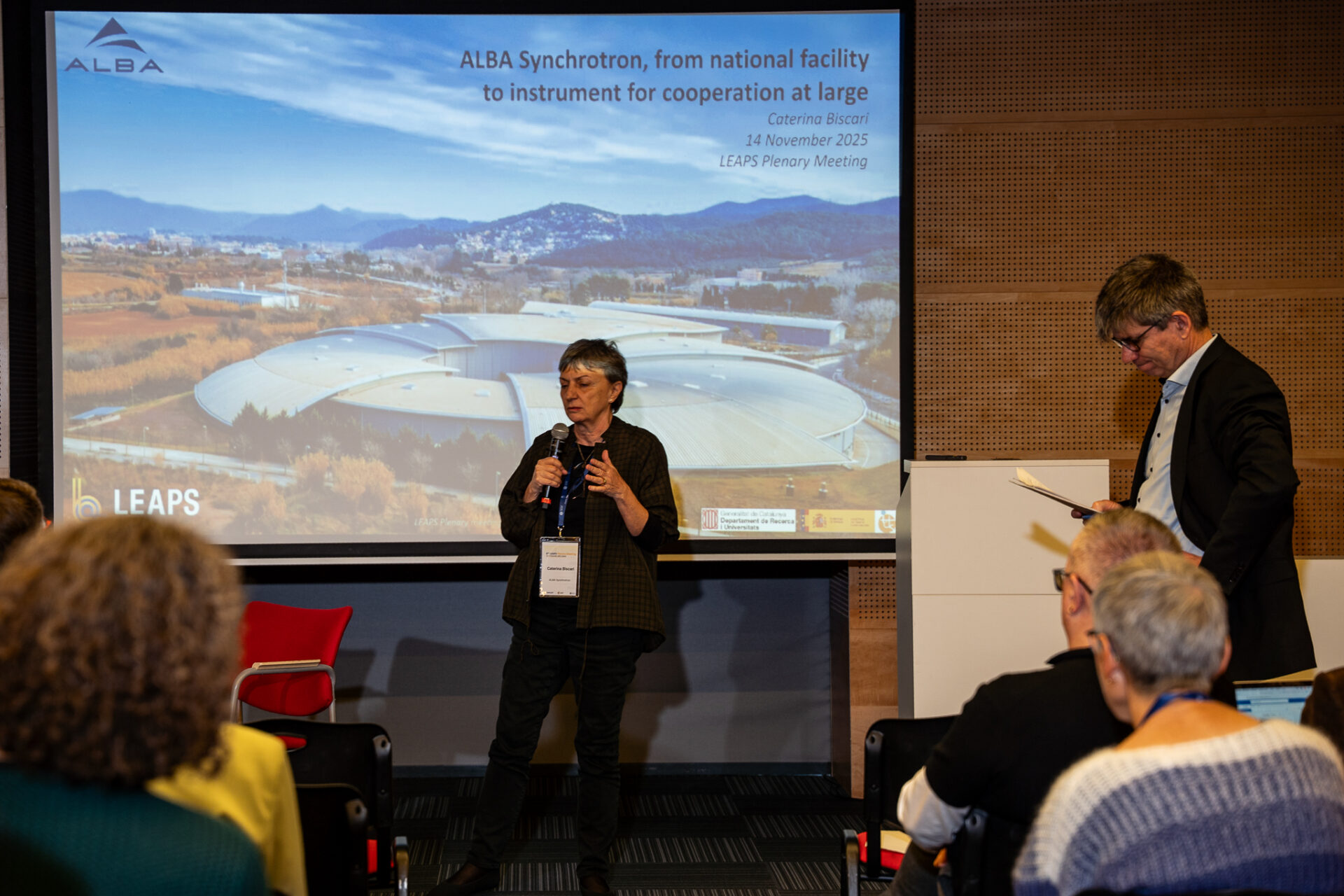
In the fast-evolving world of synchrotron research, Spain’s synchrotron facility- ALBA- has emerged as a striking example of how science can transcend borders and fuel innovation. Caterina Biscardi, director of ALBA since 2012, traces its origins to a visionary national project nearly two decades ago. “When ALBA started, we had 350 users. Last year, it was 3,500,” she notes. This growth reflects not only the expansion of services – from remote access to industrial partnerships – but also the facility’s increasing global reach. The facility’s international footprint is equally impressive: about half of ALBA’s users come from outside Spain, and 40% of research proposals originate from abroad.
ALBA’s evolution mirrors a broader trend: modern research infrastructures are not isolated national assets – they are global ecosystems tackling shared challenges. As facilities advance toward fourth-generation technologies, collaboration across continents is key to addressing pressing global issues, from climate change to health crises.
“We are in a world where there are global challenges, global threats. We need global solutions,” Ms Caterina asserts. ALBA’s story illustrates that the power of synchrotrons lies not only in their beams of light but in their capacity to illuminate paths toward shared knowledge, innovation, and international cooperation.
Roundtable Discussion: Questions, Answers, and Conclusions how Research Infrastructures Foster Collaboration in a changing world.
The keynote speakers reflected on the common themes raised during the debate: Collaboration Among Complexity, Access as a Foundation for Trust, Keeping the Doors Open, Balancing Openness and Responsibility and The Role of Social Sciences.
Can science remain open, trusted, and globally accessible- or will geopolitics reshape its foundations?
Hosted in front of an audience deeply invested in the future of scientific cooperation, the debate spanned issues from technological gaps, inequalities in science to fake news, from the erosion of academic integrity to the role of TikTok in science communication. What emerged was a timely portrait of science caught between two forces: increasing pressures for sovereignty and the enduring need for global collaboration.
Panellists agreed that the relationship is mutually shaping. Scientific communities must navigate political realities, but they also hold moral and practical authority to advocate for openness, equity, and long-term thinking – especially in fields where global challenges, such as climate change or energy, cannot be solved in isolation.
Across the discussion, a consistent message emerged: research infrastructures are uniquely positioned to keep international cooperation alive in turbulent times. Their very design requires collaboration. Their success depends on trust. And their impact extends beyond scientific breakthroughs to diplomacy, capacity-building, and shared societal progress.
Yes, national priorities, sovereignty, and geopolitical pressures create tension. But as the panellists emphasized, these forces do not make collaboration impossible. They simply require intentional governance, responsible openness, and stronger networks.
In a world fractured by conflict and competition, research infrastructures serve as quiet but powerful bridges – proving that collaboration is not only compatible with national interest, but essential to solving the global challenges we all share.