WG1.4 Photon Diagnostics
Europe’s synchrotrons and free-electron lasers produce some of the brightest X-ray light in the world. Scientists use it to track chemical reactions as they happen, design new medicines and materials, and study matter at the scale of atoms. To make the best use of this light, facilities must be able to measure it precisely and continuously: its intensity, position, colour, focus and coherence, and, for the shortest pulses, their duration and timing. That is the role of photon diagnostics.
WG1.4 brings together diagnostics experts from free-electron lasers, synchrotrons and metrology institutes across Europe. Together, we pursue three goals:
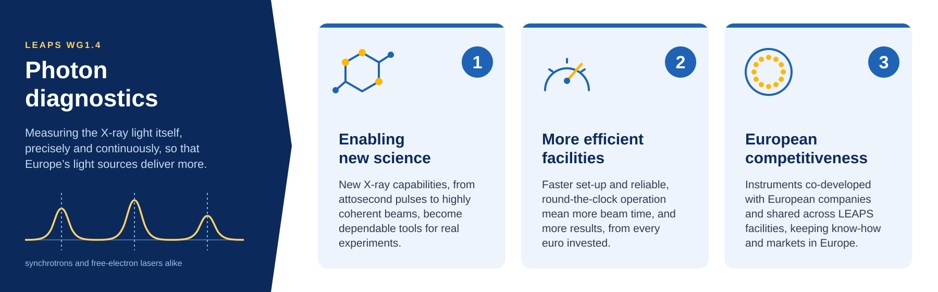
- Enabling new science. Many of the most exciting new capabilities, such as attosecond pulses at free-electron lasers and the highly coherent beams of upgraded synchrotrons, can only be offered to users once they can be measured reliably. Diagnostics turn an experimental machine setting into a tool scientists can depend on.
- More efficient facilities. Better diagnostics shorten set-up times and keep beams stable around the clock. The result is more beam time and more scientific results from every euro invested in Europe’s research infrastructure.
- European competitiveness. Where suitable instruments do not exist, we develop them with European companies and test them across LEAPS facilities. This builds products and know-how that stay in Europe.

- Since 2020, the group has grown into a network of more than 25 experts from about 20 institutions. These include free-electron lasers, synchrotrons, a national metrology institute and universities, as well as SESAME in the Middle East.
- We contributed to the photon diagnostics chapter of the LEAPS Technology Roadmap, which sets Europe’s development priorities in this field.
- We launched the virtual diagnostics initiative. It uses machine learning and existing measurements to work out properties of the X-ray beam that are difficult or impossible to measure directly. Workshops at DESY (2023), Frascati (2024) and DESY (2026) brought together experts in diagnostics, accelerators and data science. Tools developed in this work are now used in day-to-day operation. One example estimates the duration of every X-ray pulse at SwissFEL from a single spectrum.
- Our ideas formed the basis of the PulseDiag work package in the LEAPS-TECH project. PulseDiag develops shared European instruments for measuring ultrashort pulses down to the attosecond scale and their precise arrival time.

- Push-button wavefront sensing. Wavefront sensors show how well an X-ray beam is focused and how it can be improved, but they are still difficult to use routinely. With a European optics company, we are developing a turnkey, online system that any facility can run. Joint testing at European XFEL is planned for late 2026 to early 2027.
- Virtual diagnostics. We are building shared machine-learning tools, together with open datasets that follow the FAIR principles, so that every facility can benefit from methods first developed at one site.
- Ultrashort pulse diagnostics. Work continues through LEAPS-TECH on measuring attosecond pulses and pulse arrival times.
- Future European projects. We are preparing work packages for the next Horizon Europe research-infrastructure technology call. They focus on co-development with industry and on uses beyond the facilities themselves.
- Sharing know-how. Regular meetings, focused workshops and joint beam times across partner facilities allow new prototypes to be tested quickly and good practice to spread.

| Kai | Tiedtke (Spokesperson) | DESY | kai.tiedtke@desy.de |
| Christopher | Arrell (Spokesperson) | PSI | christopher.arrell@psi.ch |